OPEN RESEARCHPUBLIC WORKBENCHEVIDENCE-GUIDEDNO ACCOUNT REQUIRED
CLEAN COMPUTEOne problem. One workbench. A clearer path to what matters next.
A public, evidence-guided investigation workbench for difficult compute, energy and infrastructure systems. Keep research, calculations, competing scenarios, tests, reported outcomes and handoff in one continuous body of work.
Use it as a rigorous second opinion.Current guidance is deterministic, not a connected AI research service. Supplied sources, calculations, reported observations and unknowns stay distinct. Clean Compute is not certification or authorization to act.
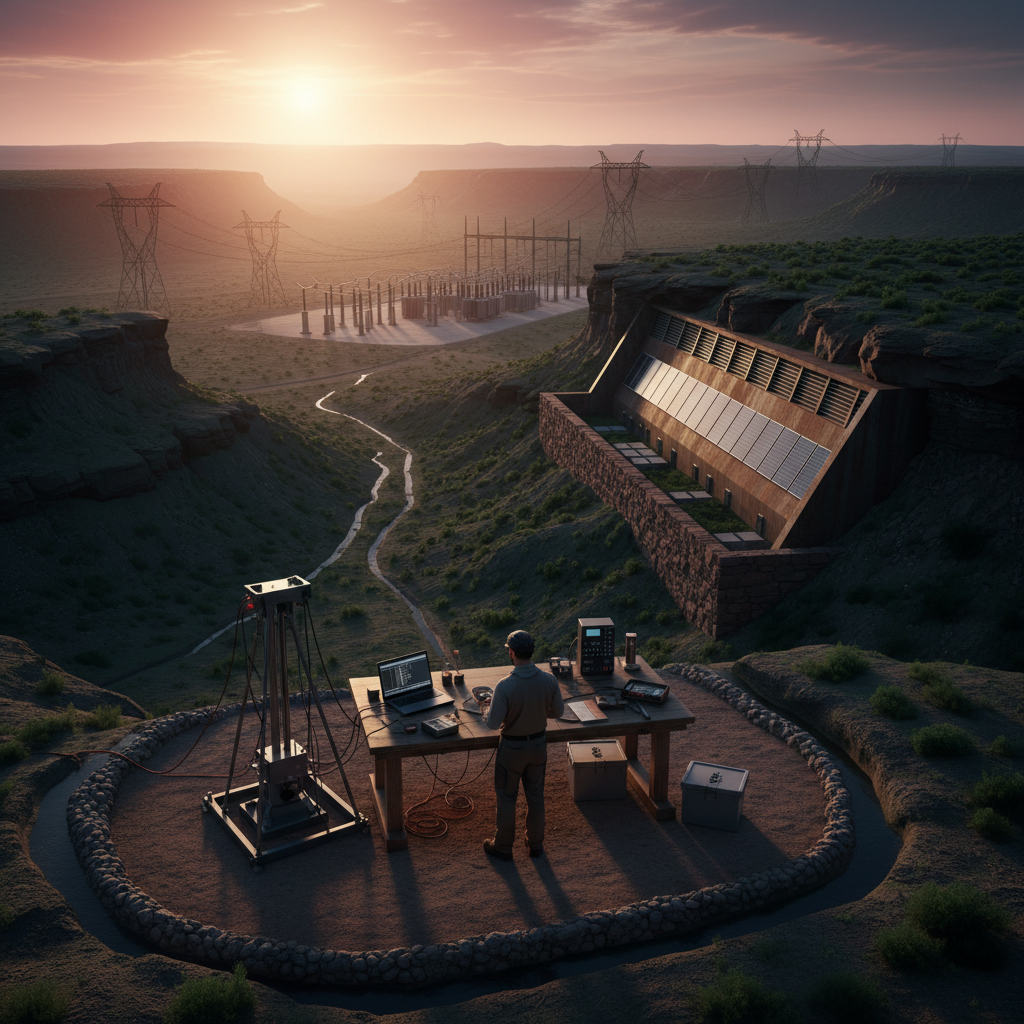
These images establish context and identity. They are not evidence about your investigation.
ONE INVESTIGATION WORKBENCH
Stay with the problem. Clean Compute brings the right instrument to you.
No account required. Start with details or resume saved work. Your investigation stays in one record while the smallest sufficient capability wakes around the current frontier, then returns to rest when it is no longer needed.
NO-ACCOUNT CONTINUITY
Saved in this browser
Your current investigation is autosaved locally after changes. Clearing browser data or using another browser or device can remove this copy.
YOUR WORK
What are you working on?
INTAKE REVIEWSupplied: Problem statement · Facility load · Average utilization · Location / grid region · Target year · Limited-water constraintStill unresolved: No intake gaps listedSupplied material remains INPUT until evidence or observation establishes more.
INVESTIGATION
Support a 300 MW data center in Arizona with 24/7 operation, limited water, a constrained grid, and a target opening in 2030.
SUPPLIED✓ 300 MW target load✓ Location: Arizona✓ Target year: 2030✓ Limited-water constraint
UNCERTAIN? Required reliability / uptime target? Available grid interconnection capacity and timing? Acceptable capital and operating cost envelope? Useful compute-work requirements and valid workload-to-energy attribution? Compute-to-power-to-cooling dependencies and boundary completeness
CALCULATION · v1
2,628 GWh/yearAnnual energy requirement
- Inputs
- Facility load: 300 MW [INPUT] · Average utilization: 100 % [INPUT]
- Formula
- Facility load (MW) × average utilization × 8,760 hours/year ÷ 1,000
- Assumptions
- Utilization is treated as the average fraction of target load sustained across the year. · One calendar year is represented as 8,760 hours.
- Class
- CALCULATED
- Does not establish
- Site feasibility, Delivered grid capacity, Interconnection timing, Cost, Reliability, Water use, Observed performance.
- Source trail
- Input sources stay attached to this calculation. The result remains a calculation, not an observed fact, and it does not make source claims stronger.
ONE WORKBENCH · CONNECTED PROFESSIONAL INSTRUMENTS
Research, work, test and deliver—without leaving the investigation.
Every instrument shares this investigation. Sources remain attributed; calculations remain calculations; user-reported observations are not independent verification.
Investigation activeCurrent scope is relevant. Inspect only the next decision-changing unknown.
INVESTIGATE
RESEARCH · SOURCE DOCK
Sources linked to the current investigation
Record source identity, claim, limitation, provenance root and which open question it addresses. Attaching a URL does not inspect or verify it.
0 attached0 declared roots · unverified0 flagged conflicts0 flagged stale
Earliest useful uncertainty · 5 bounded questions
Priority is a transparent rule for selecting the next question—not a confidence score or evidence of correctness.
Deliverable capacity — UNKNOWNNeeded: Site-specific grid operator service capacity record tied to actual facility and target date
Queue or study position — UNKNOWNNeeded: Exact project interconnection queue/study status and conditions
Infrastructure upgrades — UNKNOWNNeeded: Utility-required transmission/substation/protection upgrade documentation
Energization and regulatory timeline — UNKNOWNNeeded: Authoritative milestones, permits and restrictions for this exact site
Original record — UNKNOWNNeeded: Primary source identity, time, version and complete context
Source independence — UNKNOWNNeeded: Direct source ancestry and dependence on other reported records
Discriminating observation — UNKNOWNNeeded: A test capable of rejecting at least one competing explanation
Source and legal availability — UNKNOWNNeeded: Site-specific authorized water access and shared-resource constraints
Meter boundary — UNKNOWNNeeded: Water flow/consumption records with declared site and time
Cooling duty — UNKNOWNNeeded: Seasonal heat-rejection and cooling design inputs with protected temperature
Community consequence — UNKNOWNNeeded: Material external effects with direct observations and authority
Original record — UNKNOWNNeeded: Primary source identity, time, version and complete context
Source independence — UNKNOWNNeeded: Direct source ancestry and dependence on other reported records
Discriminating observation — UNKNOWNNeeded: A test capable of rejecting at least one competing explanation
Useful workload specification — UNKNOWNNeeded: Frozen task identity, accepted output/quality and service target
Comparable baseline — UNKNOWNNeeded: Matched hardware, code, inputs, clocks, retries and start/end of observation
Resource telemetry — UNKNOWNNeeded: Attributable CPU/GPU/memory/network/energy instrumentation and counter semantics
Protected service result — UNKNOWNNeeded: Matched latency, throughput, reliability and failure-mode observations
Inspect public reference material
Look up a Wikipedia article inside this workbench. This retrieves current article context only; it does not verify an engineering claim.
No user sources attached yet. The existing example references elsewhere on the page are background context, not site-specific proof.
All manually attached sources remain user-supplied and unverified. Different source-root names do not prove independence; live retrieval and independent claim validation are separate operations.
1. A LARGER PICTURE
The hardest problems today aren’t isolated.
2. INTERCONNECTED SYSTEMS
Compute. Power. Water. Communities. They’re connected.
3. THE TRAP
A solution isn’t progress if it only moves the problem somewhere else.
4. A DIFFERENT START
CLEAN COMPUTE
Real problems. Clear reasoning. A more grounded tomorrow.
5. A REAL PROBLEM
FLAGSHIP INVESTIGATION
300 MW Data Center — Arizona
Support a 300 MW data center in Arizona with 24/7 operation, limited water, a constrained grid, and a target opening in 2030.
6. SEE ENOUGH OF THE WHOLE
CONNECTED FACTORS
What affects this problem?
Look broadly enough to catch consequences, then focus on what can change the decision.
FOCUSED AREA
Grid
Available interconnection capacity and delivery timing can determine whether an otherwise plausible energy plan is feasible.
AFFECTSPower · Generation · Storage · Community
LOOK AT NEXTVerify site-specific interconnection capacity, queue status, transmission constraints and delivery timing.
Whose or what perspective could materially change how this problem is bounded?
System / operator
Water / cooling
Reliability / continuity
Perspectives expose missing questions; they are not evidence and do not establish a claim.
7. WHAT DO WE KNOW?
Evidence & Uncertainty
These labels identify how material entered the work. Reference publications are background context, not proof of a project's site-specific feasibility.
IINPUT4
CALCULATED1
BACKGROUND CONTEXT3
?UNKNOWN5
SOURCE REVIEWUser-attached references: 0 · not independently verified.International Energy Agency · CONTEXT ONLY · Data-centre expansion is a major driver of U.S. electricity-demand growth through 2030.
Limit: System-level forecast; not a site-specific load, interconnection, price, or project-feasibility finding.International Energy Agency · CONTEXT ONLY · Grid capacity and connection queues are material bottlenecks for new generation, storage and large loads.
Limit: Does not establish site-specific available capacity, queue position, upgrade cost, or delivery date.Lawrence Berkeley National Laboratory · CONTEXT ONLY · U.S. data-centre electricity use has grown rapidly and future demand is appropriately represented as a scenario range rather than a single certain value.
Limit: National modelling cannot establish the load, cooling design, water use, or grid conditions of an individual project.
8. CHALLENGE THE OBVIOUS
Competing Explanations
A
Solar + long-duration storage
B
Solar + geothermal
C
Grid + renewables + storage
D
Nuclear / advanced nuclear
9. DEEPEN WHERE IT MATTERS
Decision-Relevant Uncertainties
Available grid interconnection capacity and timing
Required reliability / uptime target
Acceptable capital and operating cost envelope
Useful compute-work requirements and valid workload-to-energy attribution
10. PROTECT WHAT MATTERS
Protected Dimensions
11. TEST, DON’T ASSUME
Discriminating Test
What is the actual site-specific interconnection capacity and delivery timing?
12. REALITY GETS THE VOTE
Observe and Compare
TARGET OUTCOME — OBSERVED STATE
Target
PROTECTED DIMENSIONS — OBSERVED STATE
Water
Reliability
UNKNOWNNo observed outcome has been supplied yet. Independent source verification has not been performed.
13. LEARN AND CONTINUE
Review what happened
More observation needed
Observe the real system before changing the model.
14. A MORE GROUNDED TOMORROW
Understand it.
Test it. Improve it.
Prove what changed.
CLEAN COMPUTE
Start with what must be true.
METHOD
Inspect how the investigation stays grounded.
Open this only when you need to inspect why the investigation moved, what evidence would be enough, or why it stopped.
TAKE YOUR WORK
Review it, print it, or take it with you.
Available grid interconnection capacity and timing
Bounded packet shareable — The current report can be shared without strengthening its claims.
NEEDS EVIDENCE
What is the actual site-specific interconnection capacity and delivery timing?
WHAT CAME BACK FROM REALITYTarget: UNKNOWNWater: UNKNOWNReliability: UNKNOWNReview: More observation needed
UNKNOWN stays UNKNOWN. The report cannot strengthen unsupported claims.